
Who’s Scaling is a revenue-and-momentum bar, not a viral-product list
TrendMetric Research7 min read
A +400% jump looks like scale until you ask what the base was. Most “what’s scaling” lists are percentage leaderboards: a thin niche, a short window, and a screenshot that treats both as proof. Who’s Scaling answers a narrower question than Trending Markets: which markets look like they are moving now, with enough modeled revenue that the movement matters.
The board is a display ranking on top of the same catalog. Estimated revenue, TAM, MarketScore™, demand, and country switching are the same helpers as the full market board — see estimated revenue and MarketScore™. Tiny markets cannot win on percentage growth alone. That is the product, not a missing filter.
This article is the size-and-momentum pass. It is not a store spy, not a viral SKU feed, and not a ROAS model. If you still need the category sized before you care about acceleration, stay on Trending Markets. If you already have a SKU and need a go / no-go before ads, use how to validate a product idea.
What “scaling” means on this board
On TrendMetric, scaling is a stored-history read with a floor. A market has to clear stored estimated-revenue rules and still show positive recent momentum on 30D and 90D. Worldwide uses worldwide tiers. A country uses country demand and finer revenue buckets, still under the same TAM ceiling. If a country has no stored demand that still clears the floor, the market does not appear as Scaling Now.
Status labels such as Breakout, Emerging, Stable, Cooling, and Seasonal still come from the live market snapshot. You are not looking at a second universe of markets. Who’s Scaling only changes who leads the list after size is already in the picture.
A practical example: protein powder vs a thin accessory spike
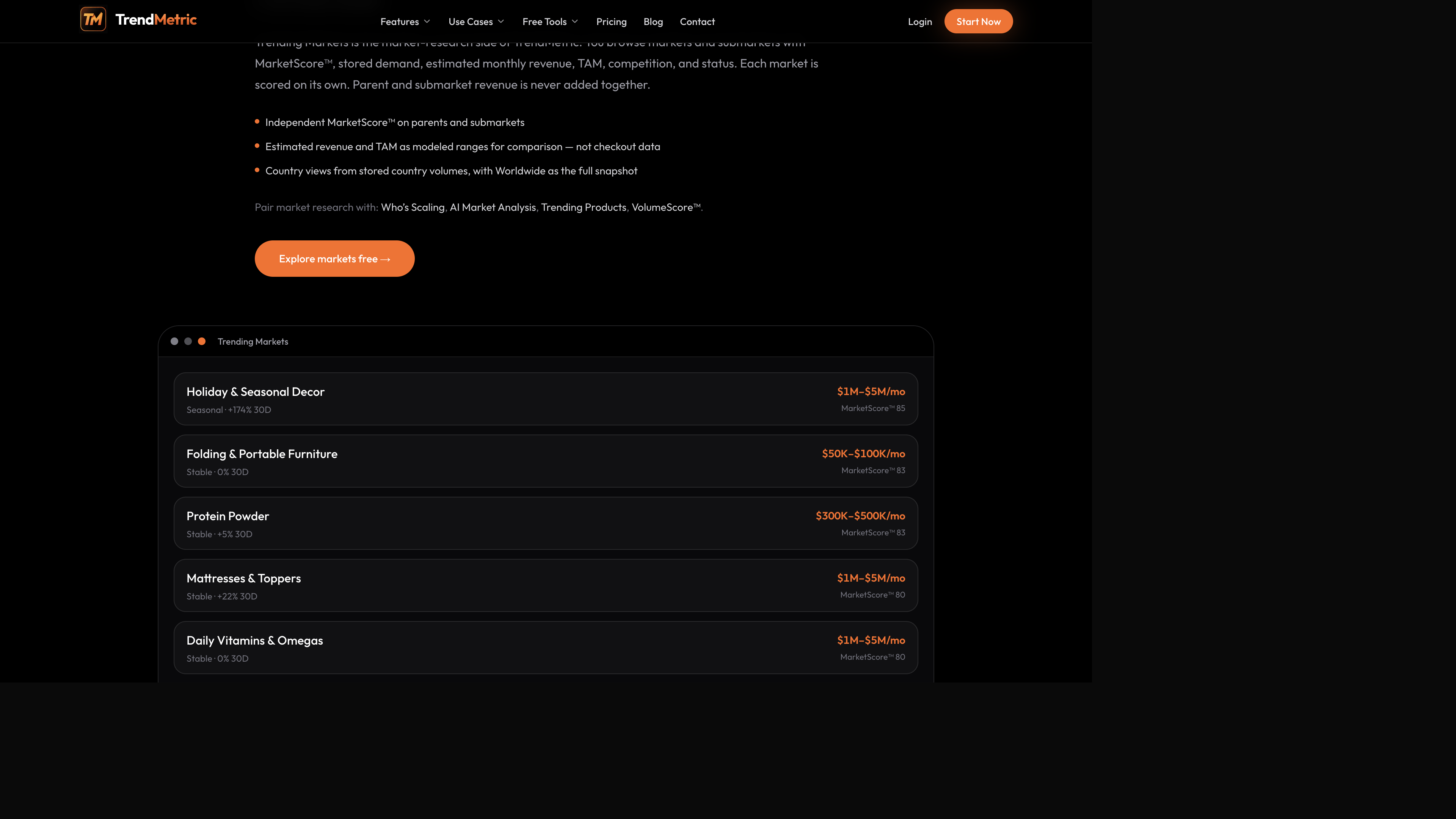
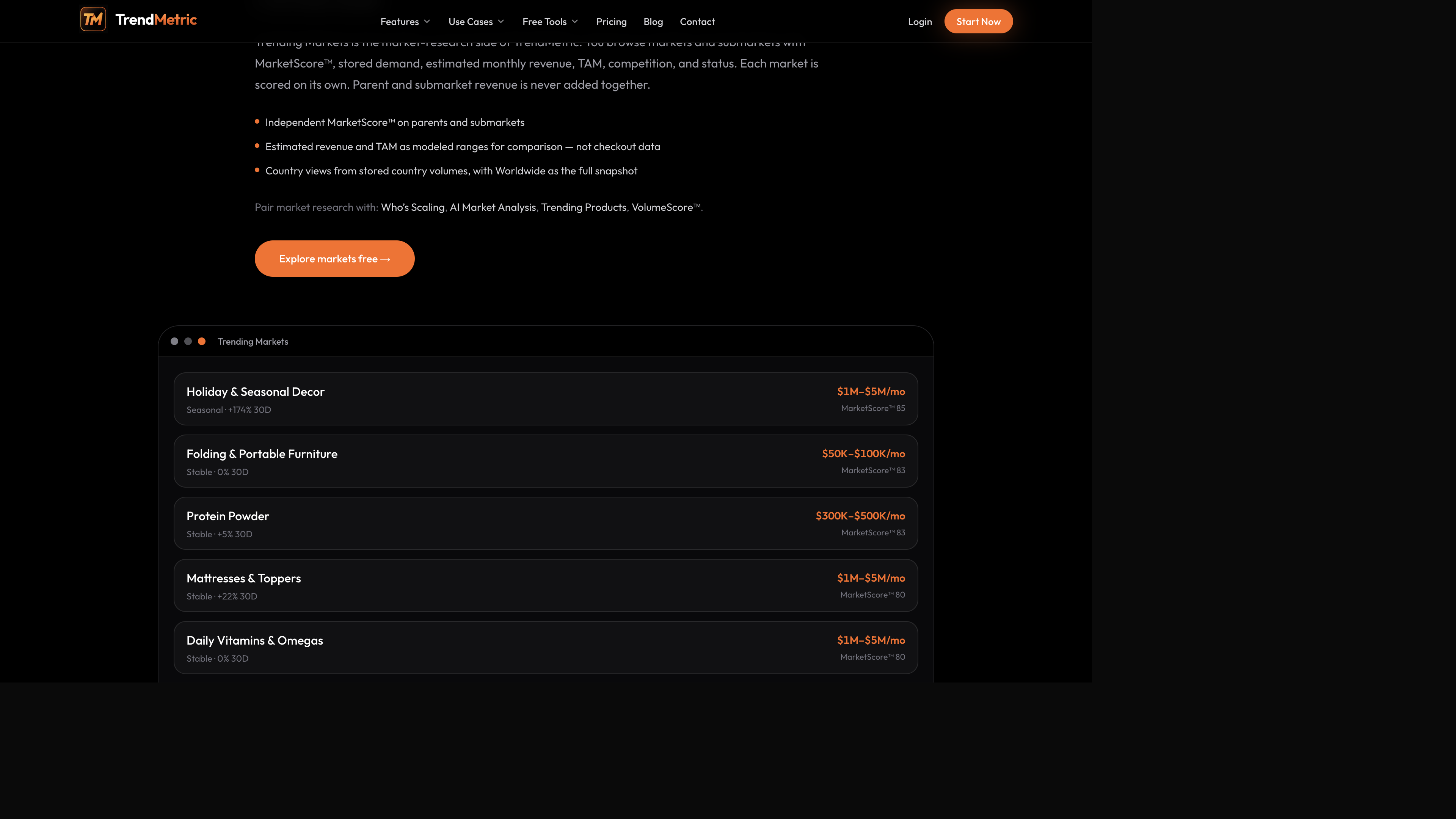
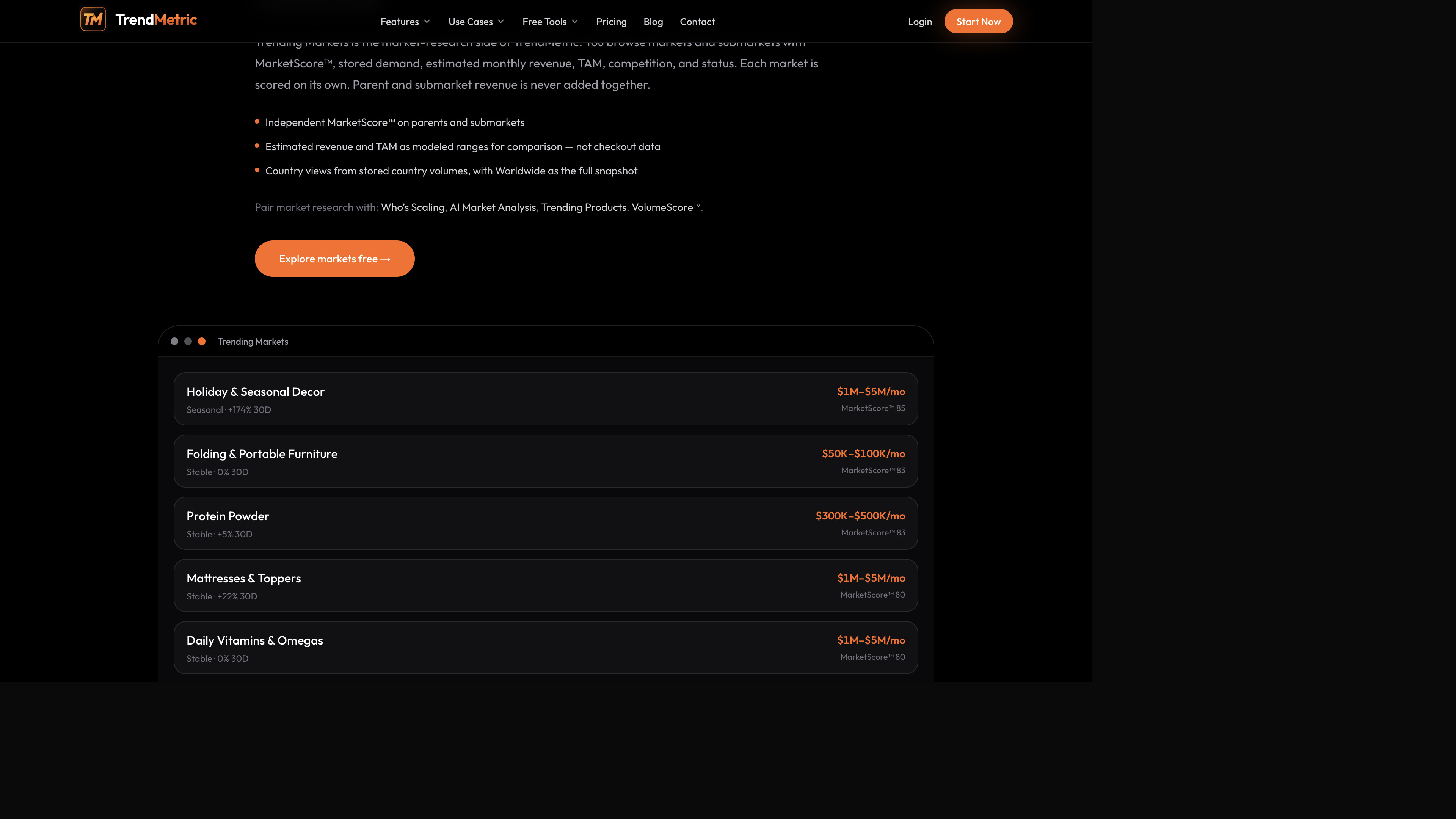
Suppose two categories both look “hot” in a creator feed. One is a parent aisle that already shows a wide modeled revenue band on the market cards — protein powder is a useful Stable example on the Trending Markets preview. The other is a thin accessory whose 30D percentage looks huge because last month was almost empty.
On the full board, both can appear. On Who’s Scaling, the thin accessory usually fails the revenue floor. That is not a judgment that the accessory cannot sell. It is a judgment that percentage growth on a tiny base is a test, not a scale brief. Media buyers use that distinction before they raise budgets. Dropshippers use it so a viral clip does not become a bulk order.
Holiday decor and folding furniture tell a different story on the same cards: one is Seasonal with a wide modeled range, the other can look smaller and still be a cleaner test if crowding is lower. Do not add those ranges together. Do not add a submarket to its parent. Who’s Scaling will not do that math for you — it only asks whether the market you are looking at already looks large enough and is still moving.
What to write in the research note
- Market name and whether it is a parent or a submarket — never both TAM figures added.
- Geography: Worldwide vs the country of the account you actually run (country vs Worldwide).
- Estimated revenue range plus 30D, 90D, status, and MarketScore™ on one line.
- Whether the row cleared Who’s Scaling’s floor, or only looked loud on the full board.
The six-pass scaling workflow
Use this when you have 20 minutes and a niche you are tempted to treat as “already scaling.” The point is a shortlist of markets that clear size and still accelerate — not a viral-product import list.
- Open Trending Markets first. Read estimated revenue as a range and MarketScore™ as a rank. If the category is not large enough to care about, stop. Who’s Scaling will not invent size.
- Switch to the country you sell or the ad account you run. Worldwide is the full snapshot. A country is a stored slice. Do not add them. See country demand vs Worldwide.
- Open Who’s Scaling. Confirm the market still clears the revenue floor and shows positive 30D / 90D momentum. If it disappears here, treat “hot growth” as a test, not a scale.
- Compare siblings, not parent plus child. A submarket is not extra money on top of the parent. Brand owners use that hierarchy when a SKU sits in a tight intent inside a larger aisle.
- If you have Pro, Forecast a catalog product inside the market on a short horizon. Scale / Test / Watch / Caution is a demand stance, not a media plan.
- Track the market and a handful of products so 7D / 30D starts today (Track starts the clock). Track Forecast is not live.
How country switching changes the floor
Country switching reuses stored country volumes. It is not a live Ads API call on every click. Worldwide uses a higher estimated-revenue floor than a single-country view because the worldwide tiers are larger. A market can look Scaling Now in one geography and fail the floor in another. That is stored demand, not TrendMetric boosting a country.
If you research for clients, pick one country per brief and put it on the project so notes and later forecasts do not mix geographies. Ecommerce agencies should not brief a US campaign off a worldwide Scaling Now label.
What Who’s Scaling will not do (on purpose)
- It will not list growing Shopify brands, ad accounts, or yesterday’s spend. Spy on Store is Coming Soon.
- It will not invent a market that is not already on Trending Markets.
- It will not treat a huge 30D percentage on a tiny base as scale.
- It will not replace live MarketScore™. AI Market Analysis is a monthly-snapshot brief of the same board, not a second ranking.
That constraint is the method. You rank markets that already have modeled size, then you decide what to test with your own offer, creative, and suppliers. Product researchers use it as a filter after the full board. Media buyers use it as a permission check before they treat a niche as scale-ready.
Read 30D next to 90D after the floor
The ranking needs positive recent momentum, not a single loud week. A market can clear the revenue floor and still be a Watch if 30D is up and 90D is flat — that is a short window on a large base, not a durable aisle. The inverse also happens: 90D still positive while 30D cools. Write both windows in the note. Who’s Scaling is not a substitute for reading the series.
Worldwide uses a higher floor than a single-country view. A market can look Scaling Now worldwide and fail the country floor you actually sell. That is stored demand, not a bug. If the country view is empty after the request finishes, the market does not appear as Scaling Now in that geography. Do not paste the worldwide label into a local brief.
After the shortlist: SKU, forecast, track
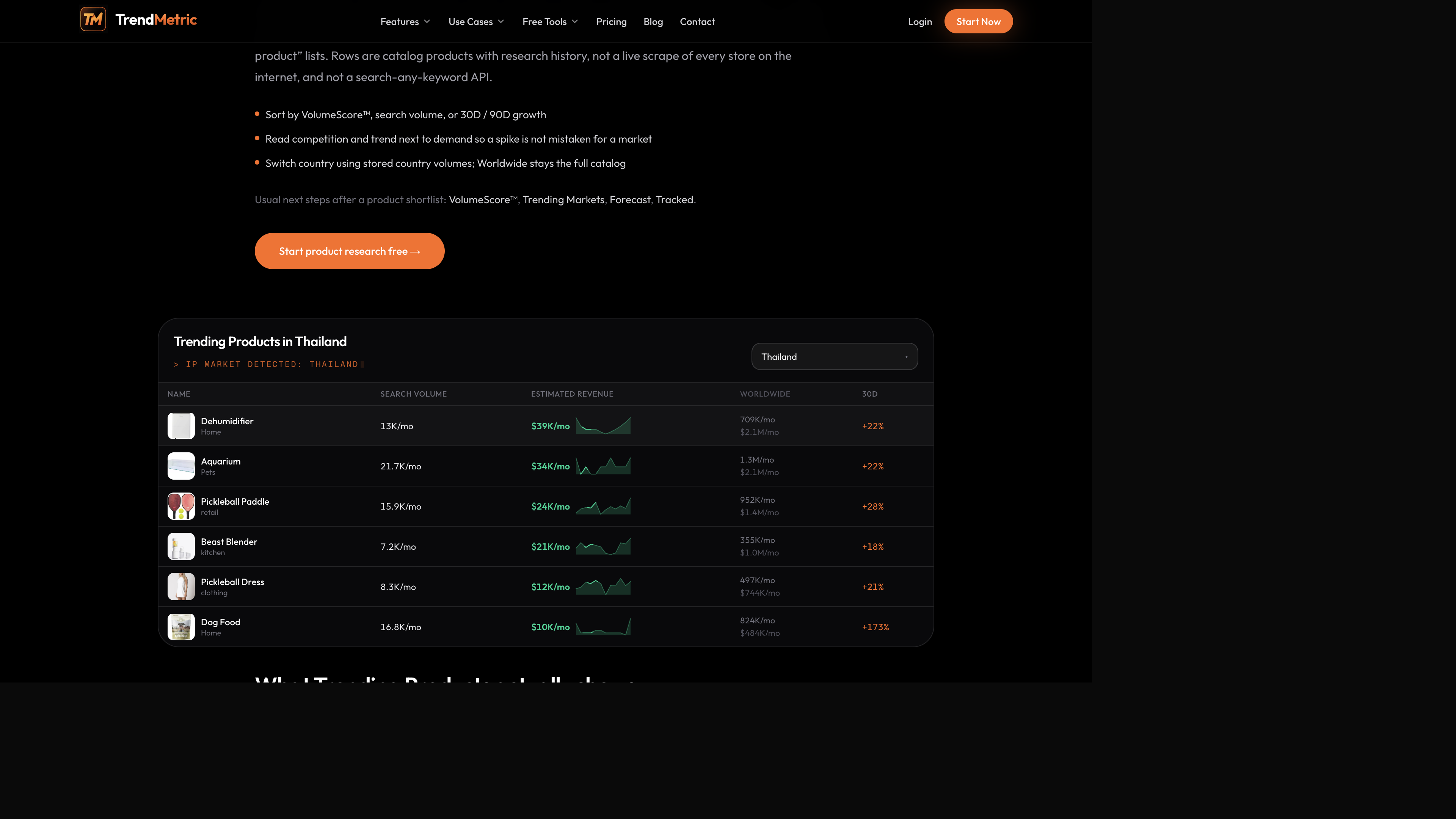
When two or three markets survive, open Trending Products inside the category. VolumeScore™ is a research rank, not a green light. High competition plus Cooling trend is a reason to keep the test small even if the parent market cleared Who’s Scaling. A dehumidifier or aquarium row on a Thailand product table can look busy on 30D and still be the wrong SKU for a US account. For the demand-first SKU pass, read how to find trending ecommerce products.
If you have Pro, forecast a short horizon on a catalog product in that market. Limited confidence means the series is thin — do not spend to invent certainty. Then Track the market so later change has a start date. Optional Tracked emails are opt-in in Settings on a paid plan. AI Market Analysis can add a monthly-snapshot brief of the same board; it does not replace this ranking and it is not a spend chat.
Who this board is for
Operators who have been burned by percentage-growth charts should start here after the category already looks large. Agencies briefing a retainer can show which sizable markets are still accelerating on the same numbers as Trending Markets. Pricing for the workspace is in which TrendMetric plan you need — Who’s Scaling is Pro, not a reason to skip the catalog boards on Starter.
If you only wanted a viral-product list, this page will disappoint you on purpose. Rank stored markets that already clear a revenue bar, then decide what deserves a test. That sequence is also market research before spend.
Related articles
FAQ
- Does Who’s Scaling list growing Shopify brands?
- No. It ranks catalog markets, not individual stores or ad accounts. Spy on Store is Coming Soon. You will not get brand URLs or yesterday’s spend.
- Is the revenue number different from Trending Markets?
- No. Estimated revenue, TAM, demand, and country switching use the same helpers as Trending Markets. Who’s Scaling is a ranking rule on top of that board, not a second model.
- Why don’t small fast-growing markets always win?
- The ranking requires a meaningful estimated-revenue floor first. Percentage growth on a tiny base is not enough to lead the list.
- Which plan includes Who’s Scaling?
- Pro and Business. Starter includes Trending Markets and Trending Products without this ranking. AI Market Analysis and Forecast are also Pro.
- Can I use Who’s Scaling with a country view?
- Yes. Country switching reuses stored country volumes. Worldwide uses a higher floor than a single-country view. Do not add the two geographies together.